


No WiFi baby monitor reviews: real home testing and top choices
For purchasing managers and cross-border retail distributors, product recalls due to network vulnerabilities can devastate a brand's reputation overnight. The market is witnessing a massive pivot back to secure, localized transmission as parents actively reject easily compromised smart home networks. Sourcing a highly reliable baby monitor camera no wifi is no longer just a niche request; it is a critical inventory requirement for maintaining stable profit margins and high consumer trust. When evaluating potential suppliers, the focus must shift from flashy cloud features to rock-solid hardware stability, stringent factory testing, and flawless international compliance. Relying on incomplete certifications or unstable supply chains guarantees customs clearance headaches, elevated post-sale customer complaint rates, and damaged retailer relationships. Are you confident that your current nursery equipment supplier can meet the strict hardware demands of today's privacy-focused parents while protecting your distribution bottom line?
Why choose a no-WiFi baby monitor?
From a commercial distribution standpoint, stocking closed-loop nursery devices drastically reduces your post-sale customer service overhead and minimizes the dreaded Return Merchandise Authorization (RMA) rate. Unlike IP cameras that rely on third-party home routers—which inevitably lead to technical support tickets complaining of latency, dropped connections, or complicated application pairings—a localized 2.4GHz FHSS system works flawlessly straight out of the box. This operational simplicity protects the wholesale baby monitor supply chain from the slow bleed of technical returns, ensuring a stable and highly profitable product lifecycle. When a product functions independently of external internet infrastructure, the manufacturer and the retailer retain total control over the user experience, free from the unpredictable variables of consumer-grade internet service providers.
This standalone architecture is particularly attractive to privacy-conscious consumer demographics. By operating entirely offline, these systems eliminate data transmission over public networks, ensuring absolute zero risk of remote hacking, data mining, or unauthorized visual access. Parents are increasingly aware of the dangers associated with cloud data breaches and are actively seeking hardware alternatives that keep their intimate household footage strictly within the physical boundaries of their home. For brands looking to build or expand an OEM custom monitor line, leaning heavily into this privacy-first narrative translates directly into higher retail profit margins and unshakeable brand loyalty. When consumers know their child's video feed never leaves the confines of their house, they are willing to invest in premium, high-quality hardware that guarantees peace of mind.
| Evaluation Metric | Non-WiFi (2.4GHz FHSS) | Cloud-Based WiFi Systems |
|---|---|---|
| Privacy & Security | 100% closed-loop, proprietary protocol | Vulnerable to network breaches and data mining |
| Setup & Usability | Plug-and-play, zero network configuration | Requires app downloads and 2.4GHz router pairing |
| Customer Support Burden | Extremely low (isolated hardware focus) | High (router conflicts, firmware updates, latency) |
| Consumer Trust Level | Extremely high (immune to remote hacking) | Moderate to low (dependent on ongoing cloud security) |
How we tested and ranked no-WiFi baby monitors?
To determine true hardware reliability, an infant surveillance device must be evaluated far beyond standard consumer living room usage. At Anicebb, our engineering evaluation protocol simulates the harshest physical and electronic environments that a unit might encounter over years of daily parenting. We push the boundaries of these units in our ISO 9001 certified testing facility to guarantee that global B2B buyers receive flawless batches, maintaining a rigorous 99.8% factory pass rate. As a dedicated baby monitor manufacturer with 15 years of industry experience, we understand that passing basic functional tests is simply not enough for global trade.
Our comprehensive testing matrix focuses on several critical points of failure to ensure absolute supply chain stability for our distribution partners:
- Complex Signal Integrity: We test the 2.4GHz proprietary frequency across dense, high-interference zones. Engineers measure transmission clarity up to 300 meters in open environments and forcefully push signals through multiple reinforced concrete walls to guarantee no dropped frames in large, multi-story residential layouts where standard signals frequently fail.
- Physical Endurance Testing: We conduct intensive drop simulations and mechanical stress tests on the parent receivers and the motorized pan-tilt-zoom camera heads. This accurately mimics the accidental impacts expected from exhausted parents or active toddlers, ensuring the medical-grade materials and internal circuitry hold up over years of use.
- Thermal and Battery Safety: Intensive thermal chamber testing ensures that internal lithium batteries operate safely during extreme temperature fluctuations. We actively mitigate any fire hazards, battery expansion risks, or capacity degradation to protect both the end-user and the retailer from catastrophic product liability issues.
- Regulatory Compliance Verification: Every single baby monitor camera is scrutinized against international regulatory frameworks. We strictly verify CE, FCC, and RoHS compliance, assuring distributors that their maritime or air-freight shipments will clear international customs instantly without bureaucratic delays or unexpected holding fees.
Only hardware that delivers pristine high-definition feeds under these stressful conditions, while demonstrating superior power management and structural integrity, earns our top-tier recommendation for high-volume retail procurement.
Find the right non-WiFi baby monitor for your needs
Selecting the perfect inventory requires balancing modern aesthetic consumer appeal with heavy-duty internal specifications. Your end-users want a nursery device that blends seamlessly with their carefully curated home decor, while your purchasing department requires hardware backed by unquestionable manufacturing excellence, cost-effectiveness, and logistical efficiency. Balancing these two distinct demands is the key to accelerating your inventory turnover rate and maximizing warehouse space.
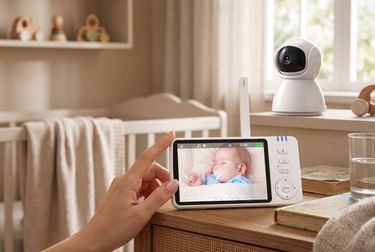
The Anicebb ABM570 stands out as an aesthetic bestseller that delivers exceptionally on both fronts. Engineered as a premium, ready-to-ship solution, it allows retailers to quickly capitalize on market demand for secure, privacy-first infant care systems. The unit features an elegant, cozy home-decor design that immediately captivates young parents, purposefully moving away from the clinical, sterile, and intimidating look of older security cameras. Beyond its visual appeal, its core hardware architecture combines high-capacity power management with smart, localized care functionality.
Key technical features that drive immediate consumer conversion include:
- Advanced Viewing Capabilities: A massive 5.0-inch HD display (1280 x 720P) is paired with a motorized PTZ camera head offering a comprehensive 355-degree pan and 95-degree tilt. It also features a 2x digital zoom and advanced infrared HD night vision for crystal-clear monitoring in pitch-black conditions.
- Superior Battery Life: The parent screen is equipped with a built-in heavy-duty 3500mAh rechargeable lithium battery, delivering up to 13 hours of continuous active working mode and an impressive 22 hours in VOX (crying wake-up) mode.
- Smart Nursery Integrations: Beyond simple video transmission, the unit is packed with utility. It includes real-time room temperature detection, customizable feeding reminders, integrated soothing lullabies, and crisp two-way audio talk functionality.
- System Scalability: Dual camera support allows parents to monitor multiple children or distinct rooms simultaneously from a single parent unit. This built-in scalability actively encourages profitable secondary hardware upsells for retailers down the line.
From a supply chain and logistics perspective, this model is meticulously optimized for B2B cross-border e-commerce efficiency. The packaging footprint is strategically designed to maximize freight density. Each set has a gross weight of approximately 603g, safely housed in a compact color box measuring 175 x 105 x 130 mm. Our standard packing quantity is 24 sets per carton, with the master carton measuring 440 x 370 x 430 mm and weighing roughly 15.47 kg. This absolute precision in packaging ensures predictable palletization and strict shipping cost control for international buyers. Furthermore, we offer comprehensive brand identity customization, allowing you to seamlessly integrate the ABM570 into your brand's existing product portfolio.
Conclusion
Securing a reliable, hack-proof nursery system is the most effective way for maternal and infant equipment brands to capture the lucrative, privacy-conscious consumer market. By sourcing rigorously tested, fully certified, and aesthetically pleasing hardware, global distributors can completely eliminate technical support burdens and rapidly accelerate their retail sales cycles. Anicebb is ready to empower your supply chain with our factory-direct manufacturing capabilities, medical-grade materials, and premium devices like the ABM570. If you are ready to secure highly competitive wholesale pricing, request physical samples for your QA team, or wish to discuss bespoke manufacturing solutions, submit an inquiry form on the Anicebb website today to connect directly with our global partner network.
FAQ
What is the minimum order quantity (MOQ) for wholesale orders?
For our standard ready-to-ship models, our MOQ is designed to be highly flexible to support regional distributors, boutique maternal brands, and mid-sized retailers testing new inventory. If you require an OEM custom monitor featuring your specific brand logos, modified color boxes, and customized local software interfaces, the MOQ will be adjusted based on the depth of the engineering and printing required. Please contact our international sales team for exact figures tailored to your specific procurement project.
Can we request product samples before committing to a bulk order?
Absolutely. We highly encourage professional purchasing managers to request evaluation units of our baby monitor camera no wifi systems. This transparent approach allows your internal quality assurance team to perform localized, hands-on testing regarding signal strength, battery life longevity, and overall physical build quality before finalizing any large-scale procurement contracts or committing to a new supplier relationship.
What international certifications do your products hold?
Our production facilities and hardware lines strictly adhere to global regulatory standards to ensure frictionless international trade. All our non-WiFi nursery cameras are fully equipped with verified CE, FCC, and RoHS certifications. This ensures smooth, delay-free customs clearance for cross-border e-commerce sellers and retail distributors across North America and Europe. We also proudly operate under a heavily audited ISO 9001 certified quality management system.
Do you provide technical support and warranties for bulk orders?
Yes, every wholesale baby monitor order is backed by a comprehensive, factory-direct warranty to protect your investment. As a leading baby monitor manufacturer, we provide dedicated after-sales engineering support, reliable spare parts availability, and detailed troubleshooting documentation. This ensures your internal customer service teams are fully equipped to assist end-users, minimizing the need for costly returns.
Can the parent unit interface be localized for different international markets?
Yes. We understand that selling effectively in global markets requires a seamless user experience. For our distribution partners, we can customize the internal software of the parent unit to support multiple languages tailored to your specific retail region. Additionally, we can adjust the default temperature readings (Celsius vs. Fahrenheit) and modify the user manual and outer packaging to meet local language and regulatory requirements.
Contact Us

Contact Person: Mis.LEE
If you have any questions about our products or pricing, please leave your email address and we will contact you within 24 hours.
©2025 Anicebb All Rights Reserved.